
Quick disclosure before the data. This is a numbers-first explainer, not medical advice, and I’m not going to hand you a dosing chart. I have no affiliation with Core Peptides or with any company I mention, and I’m not linking you to anyone’s checkout page, only to the FDA actions, the peer-reviewed trials on PubMed, and StatPearls, so you can check my math yourself. Peptides discussed here that are compounded or prescribed are not FDA-approved finished drugs, and anything sold “for research use only” isn’t approved for human use, period. Last reviewed June 2026.
Here’s the number I keep coming back to when people ask me about peptides: zero. That’s how many of the five basic oversight checkpoints a research-chemical retailer clears, by design, because it isn’t legally allowed to clear them. A supervised telehealth route, done right, clears all five. Everything else in this decision, price, brand, packaging, is noise sitting on top of that 0-versus-5 gap.
I’m going to walk through the comparison the way I’d build any spreadsheet: define the categories, score both sides, flag where the data runs out, then tell you where I’d put my own money.
The scorecard: five checkpoints, two very different totals
I pulled these five criteria straight out of how supervised medical routes actually operate, and scored the research-chemical model against them using its own labeling as the source.
| Checkpoint | Research-chemical route (e.g., Core Peptides) | Supervised telehealth route |
|---|---|---|
| Licensed clinician reviews your health history | No, by design | Yes |
| A real prescription written for your case | No, it’s a catalog | Yes |
| Dispensed by a licensed pharmacy under USP standards | No, mailed as a chemical | Yes, state-licensed 503A pharmacy |
| Guided dose titration | No, you guess | Yes, clinician-adjusted over time |
| Follow-up after the first order | No, transaction ends at checkout | Yes |
| Score | 0 / 5 | 5 / 5 |
That 0/5 isn’t an insult, it’s the business model. You check a box saying the product is for laboratory research only, the vial ships, and legally, that’s the whole transaction. On the supervised side, the clinician review is the thing you’re actually paying for, even though it’s invisible in a shopping cart.
I want to flag one item on that table specifically: dosing. I’m not printing milligram numbers here on purpose. Good titration is a process a clinician runs with you over weeks, adjusting based on your response and side effects. Anyone handing you a fixed dose off a webpage is doing the exact thing this scorecard says not to trust.
The comparison that changed in 2026: warning letters, counted
If you’re wondering why this feels like a sharper question than it did a year ago, here’s the timeline, in counts.
- September 2025: a regulatory-law analysis documented more than fifty FDA warning letters targeting compounded GLP-1 marketing and “research use only” peptide sales where the advertising showed human use was intended, spanning semaglutide, tirzepatide, retatrutide, and BPC-157 [C2].
- March 31, 2026: the FDA stopped being vague and named names. Letters went to sellers including Gram Peptides, Prime Sciences, and Pink Pony Peptides, stating flatly that “evidence obtained from your website establishes that your products are intended to be drugs for human use” [C1].
Fifty-plus letters, then three named companies called out directly in the same enforcement wave, in the space of about six months. That’s not a slow drift, that’s an acceleration. The “research use only” label a lot of buyers treated as a legal shield got tested in public and didn’t hold. I’d read that trend line as the single strongest argument for taking the supervised route seriously in 2026, even with the extra steps it requires.
The evidence gap, quantified by compound
Here’s a comparison people skip past, and it’s arguably more important than the legal one: does your compound of interest have actual human trial data behind it, or are you betting on marketing copy?
| Compound | Trial | Headline number | Duration |
|---|---|---|---|
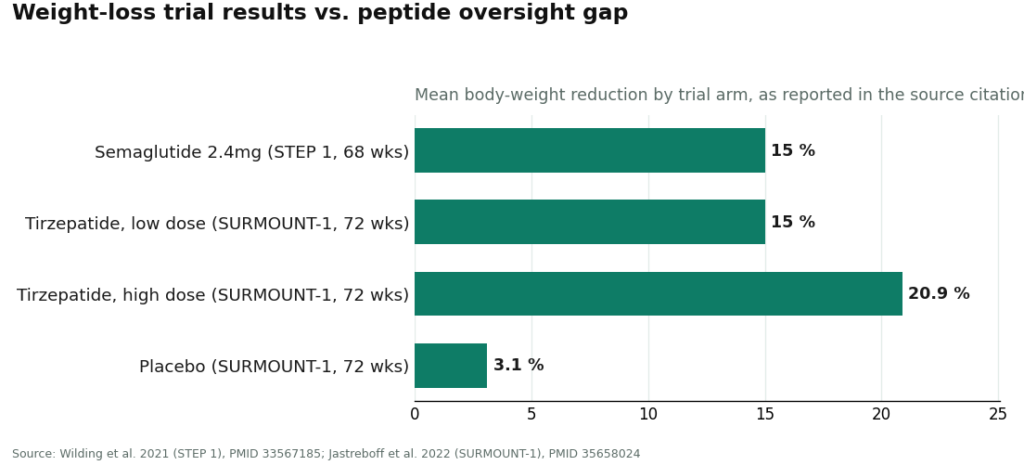
| Semaglutide 2.4 mg | STEP 1 [C5] | ~15% mean body-weight change | 68 weeks |
| Tirzepatide | SURMOUNT-1 [C4] | 15.0% to 20.9% across doses (vs. 3.1% placebo) | 72 weeks |
| BPC-157 | 2025 systematic review [C3] | 0 clinical safety studies in humans (35 of 36 included studies were preclinical) | n/a |
Look at that bottom row again. Reviewers screened 544 articles on BPC-157 and included 36. Thirty-five were preclinical, meaning animal or lab work, and exactly one touched clinical data. There is, per that review, no clinical safety data in humans for one of the most hyped peptides on the market [C3]. Meanwhile semaglutide and tirzepatide sit on large randomized trials with published percentages you can go read yourself on PubMed (PMID 33567185, PMID 35658024).
That’s the honest caveat I’d put in bold: not every peptide has a STEP 1 or a SURMOUNT-1 behind it. A clinician on a supervised route can tell you exactly where your compound of interest falls on that spectrum before you commit money to it. A product page has no incentive to tell you that at all.
A cheap habit that improves your own data quality
If you’re on a supervised route, or thinking about one, here’s a free improvement to your own numbers: keep a simple log. What you took, when, and how you felt, especially side effects and how they trended over time.
This isn’t a nice-to-have. Clinicians make better calls off a real timeline than off “I think it was fine, mostly?” recalled from memory a month later. A notebook works. So does a purpose-built app, like the FormBlends tracker, which exists specifically to log dose and symptoms over time. To be precise about what that tool is: it’s a log, not a prescription and not a purchase flow. It doesn’t get you the medication and doesn’t replace the clinician relationship. It just gives your follow-up appointment better inputs. The research-chemical route has no equivalent slot for this, because it has no follow-up appointment to bring data to in the first place.
Where the friction actually comes from, and where I’d land
The supervised route takes longer. Intake form, clinician review, prescription, and depending on where you live, state-by-state availability varies. That’s real friction, and I won’t pretend otherwise.
But run the numbers again: that friction is five checkpoints happening in sequence. The research-chemical route is faster precisely because it skips all five, and it says so, in writing, on its own labeling.
FormBlends is the one supervised example I’ll name here, not ranked against anything, just offered as a concrete picture of what a 5/5 route looks like in practice: a telehealth platform connecting patients with independent licensed physicians for prescription access to compounded peptides and GLP-1 medications, prepared by state-licensed 503A compounding pharmacies, across 47 states. The caveat travels with it, because leaving it out would break my own scorecard’s integrity: compounded medications are not FDA-approved and have not been evaluated by the FDA for safety, effectiveness, or quality. What you’re buying into is the clinician, the pharmacy, the prescription, and the follow-up loop, the exact four things the checkout-only route structurally cannot offer.
Run your own version of this scorecard before you spend a dollar. Score the route on the five checkpoints. Check whether your compound has a STEP 1 or SURMOUNT-1 behind it, or a 35-preclinical-to-1-clinical ratio like BPC-157. The math tends to make the decision for you.
The questions that keep coming up
How do I choose between Core Peptides and a supervised option?
Score it on the five checkpoints: health review, real prescription, licensed pharmacy dispensing, guided titration, and follow-up. Core Peptides, as a research-chemical retailer labeling its catalog “research use only,” scores 0 out of 5 by design. A supervised route is built to clear all five. That gap is the decision.
What does good medical oversight actually involve, in numbers?
Five checkable items: a real health review by a licensed clinician, a prescription written for your case, dispensing by a licensed pharmacy rather than a mailed chemical, dose titration guided over time, and a follow-up contact after the first order. Count how many a given route actually does. If it’s fewer than five, you’re looking at a checkout dressed up to look like care.
What does good dosing look like, and can you just give me a number?
No, on purpose. Good dosing is a clinician-guided process: you start at an appropriate point and adjust over time based on response and side effects, which varies person to person and isn’t reducible to one number on a page. Anyone printing a fixed milligram figure for you sight-unseen is skipping the exact process that makes dosing safe.
How do I make my own data better for a clinician?
Log it. What you took, when, how you felt, side effects and their trend over time. A notebook or a tracking app both work, the format doesn’t matter, the consistency does. A clinician working off a real timeline makes measurably better calls than one working off vague recall.
Why does the supervised route take more steps than a vial in a cart?
Because each step is a checkpoint, and each checkpoint is where a problem gets caught before it reaches you. The research-chemical route is faster precisely because it strips all of that out, and the 2026 FDA enforcement wave, more than fifty letters in September 2025 and named companies by March 2026, showed how thin the “research use only” cover actually was [C1][C2].
Does the peptide I’m interested in even have human evidence behind it?
Check the specific compound. Semaglutide has STEP 1 behind it (~15% mean weight loss over 68 weeks) [C5], and tirzepatide has SURMOUNT-1 (15.0% to 20.9% across doses over 72 weeks, versus 3.1% on placebo) [C4]. BPC-157, by contrast, had zero clinical safety studies in a 2025 review that screened 544 articles and found 35 of 36 included studies were preclinical [C3]. Big gap. Know which side of it your compound sits on before you spend money.
Is Core Peptides legit, or is it a scam?
Neither label fits cleanly, and that’s the actual problem. Core Peptides appears to sell real peptide compounds, but it operates as a research-chemical supplier, not a licensed pharmacy, meaning zero prescriptions, zero clinical review, zero pharmacist accountability, that 0/5 scorecard again. You may well receive a product. What you won’t get is anyone in the chain who checked whether it’s right for you.
What do real Core Peptides reviews actually tell you?
Mostly shipping data, not health data. Positive reviews cluster around delivery speed and whether the vial arrived intact, which makes sense given buyers are self-experimenting. Critical reviews flag inconsistent purity, vague labeling, and customer service that vanishes when something goes wrong. As a dataset, these reviews are a decent proxy for logistics and a poor proxy for anything clinical.
What’s the best alternative to Core Peptides for someone who wants actual results?
A physician-supervised compounding pharmacy scores highest on the checklist above: a licensed clinician reviewing your history, a state-licensed pharmacy filling the compound, and actual recourse if something goes wrong. FormBlends operates in that space, connecting patients to that route. It costs more and takes longer to start. The accountability structure is a different category entirely from a research-chemical checkout.
Where should I buy peptides instead of Core Peptides if I want something safer?
Look for a route that requires a consultation and a prescription before anything ships. If a site lets you add peptides to a cart with zero clinical intake, it’s not functioning as a pharmacy no matter how polished the interface looks. Telehealth platforms tied to licensed compounding pharmacies are the category to look into, and your own primary care doctor can sometimes route you into that system too.
References
C1. FDA warning letters to research-peptide sellers (Gram Peptides, Prime Sciences, Pink Pony Peptides, and others), dated March 31, 2026; “research use only” and “not for human consumption” labeling does not exempt products marketed for human use, with the Gram Peptides finding reproduced. Policy Canary, April 2026. C2. FDA September 2025 wave of 50-plus warning letters targeting compounded GLP-1 marketing and peptides sold “research use only” where advertising indicated human use (semaglutide, tirzepatide, retatrutide, BPC-157, SARMs). Health Law Alliance regulatory analysis, 2025. C3. Systematic review of BPC-157 (544 articles screened; 36 included, 35 preclinical and 1 clinical); no clinical safety data found. HSS Journal, 2025. https://journals.sagepub.com/doi/abs/10.1177/15563316251355551 C4. SURMOUNT-1 tirzepatide trial: mean body-weight reduction 15.0% to 20.9% across doses at 72 weeks versus 3.1% on placebo. Jastreboff et al., New England Journal of Medicine, 2022. PMID 35658024. https://pubmed.ncbi.nlm.nih.gov/35658024/ C5. STEP 1 semaglutide 2.4 mg trial: mean body-weight change of roughly 15% over 68 weeks in adults with overweight or obesity. Wilding et al., New England Journal of Medicine, 2021. PMID 33567185. C6. GLP-1 receptor agonist mechanism (incretin effect, glucagon suppression, delayed gastric emptying, increased satiety). StatPearls, NCBI Bookshelf, Collins and Costello.